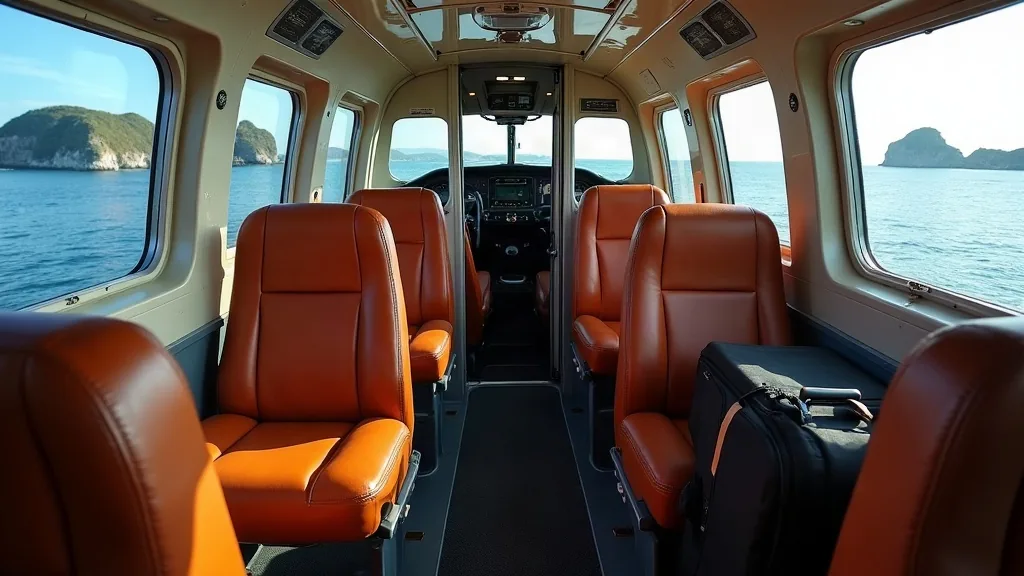
A shared seaplane seat in Indonesia works only on scheduled scenic or transfer products with open capacity, such as an 8-guest Cessna Caravan 208 EX Amphibian route, and availability shifts week to week as of September 2026. Most resort and Komodo transfers are full-charter only. The Juara Holding Group desk confirms which applies before you pay.
How Does Shared Seaplane Booking Work in Indonesia?
“Shared” means you pay for one or more seats on a flight an operator has already scheduled to run, rather than paying for the whole aircraft. This model only exists where an operator publishes a fixed departure with fixed capacity — the clearest current example is Santai Seaplane’s scenic Bali product, a Cessna Caravan 208 EX Amphibian carrying up to 8 guests on a 40-minute flight from Ngurah Rai, priced on an indicative per-guest basis (with full pricing details, including airport fees and tax, available per the operator’s published figures, subject to change).
Route-style products between regions — South Bali–Lombok, Banyuwangi–North Bali, South Bali–Sumbawa — are also structured to show a per-guest fare alongside a full-charter fare, but neither Santai nor other Indonesian operators publish a public seat-map or real-time seat inventory. That means a “shared seat” is really a request: the desk asks the operator whether a scheduled departure has open seats on your date, and the operator confirms or declines. Sama Sama Seaplanes, described on its own site (updated 2026-07-03) as Indonesia’s first sustainable seaplane operator, states it can arrange charters across the archipelago but does not publish a standing shared-seat schedule either. The Seaplane Asia group’s iOS app is the one Indonesia-linked product that explicitly markets a charter-or-by-the-seat choice across its Santai, Siam, and Samra brands — useful as market context for how the model is meant to work, not as a live booking feed the desk pulls from.
Shared Seat vs Full Charter: What Actually Changes
| Factor | Shared Seat | Full Charter |
|---|---|---|
| Price basis | Per-guest fare on a scheduled departure (e.g., for the 40-minute Bali scenic route, plus airport fee and tax; exact pricing varies per the operator’s published figures) | Full aircraft price, split however your group chooses; typically the only option once minimum group size isn’t met |
| Flexibility | Fixed departure time set by the operator; you join it or wait for the next one | You set the departure window within the operator’s operating hours |
| Luggage | Operator-dependent; no seaplane-specific kg limit is publicly listed by any Indonesian operator as of 2026 | Same — operator-dependent, but easier to negotiate extra weight when you hold the whole aircraft |
| Timing control | None — the group’s slowest passenger or the operator’s schedule decides | Full — you pick pickup, routing, and any stopover |
| Minimum pax | None required, but the flight itself may not run if too few seats sell | Effectively 1 booking party, regardless of headcount, since you’re paying for the aircraft |
| Where it applies | Scheduled scenic/transfer products only (currently the Bali-area Caravan product and similar route pages) | Komodo, Raja Ampat, Labuan Bajo resort transfers, and any route without a published scheduled departure |
The practical read: if your date matches a route an operator already runs on a timetable and a seat is open, shared seating can cut the per-person cost. If your date, party size, or destination falls outside that timetable — which covers most resort transfers, liveaboard rendezvous, and multi-stop Komodo or Raja Ampat itineraries — full charter is the only real option, because there is no scheduled flight to join.
What Does the Desk Need to Hold Your Seats?
Seaplane operators in Indonesia manage manifests the way charter aircraft do generally, not the way scheduled airlines do. Nothing is held without a name and a weight on file. To submit a shared-seat request, the desk asks for:
| Information | Why it’s required |
|---|---|
| Full name exactly as on passport | Matches the flight manifest the operator files; mismatches can bump a passenger at check-in |
| Passport number and nationality | Standard manifest field for any non-scheduled/charter flight under Indonesian aviation rules |
| Body weight per passenger (kg) | Amphibious aircraft like the Caravan 208 fly to strict weight-and-balance limits; operators weigh-balance the whole manifest, not just cargo |
| Preferred date and flexible alternate dates | Confirms whether your date matches a scheduled departure or requires a charter quote instead |
| Number of seats requested | Determines whether the group can fit a shared departure or needs its own aircraft |
| Luggage piece count and approximate weight | Feeds the same weight-and-balance calculation; no fixed kg allowance is published, so this is assessed per flight |
Passport-as-ID applies because Indonesian law treats non-scheduled seaplane flights as charter operations under the Directorate General of Civil Aviation (DGCA), which sits under the Ministry of Transportation in Jakarta, per Law No. 1 of 2009 on Aviation and Permenhub PM 33 Tahun 2022. For any flight involving a foreign-registered aircraft or foreign operator, the underlying permit process needs passenger and aircraft details submitted well in advance, so precise manifest data isn’t a formality — it’s what makes the flight legally dispatchable.
How Shared-Seat Booking Works, Step by Step
- Send your dates and route. WhatsApp the desk the departure point, destination, preferred date, and number of seats wanted.
- Desk checks operator schedule. The team asks the relevant operator (currently Santai Seaplane’s Bali-area scenic/transfer product is the clearest scheduled option) whether a departure exists near your date with open capacity.
- You receive a seat quote or a charter quote. If seats are open, you get a per-guest price; if not, you get a full-charter price and any nearby scheduled alternative.
- You submit passenger details. Full name as on passport, passport number, weight, and luggage details for every guest.
- Deposit confirms the hold. Charter operators in Indonesia typically work on a deposit-plus-balance pattern — commonly 30-50 percent upfront with the remainder 7-14 days before departure — though this is standard charter-industry practice rather than a published rule from any single Indonesian seaplane operator, so the desk confirms the exact figure for your booking before you pay anything.
- Manifest and permit paperwork close out. The operator finalizes weight-and-balance and, where a foreign aircraft or cross-border element applies, any required flight clearance.
Is Full Charter Ever the Only Option?
Yes, and for most seaplane travel in Indonesia it is the default, not the exception. Resort and liveaboard transfers into Komodo National Park, Raja Ampat, or Labuan Bajo don’t run on a public timetable — they’re arranged flight by flight around guest dates, resort pickup times, and (for Raja Ampat) the October–April liveaboard season or (for Komodo) the dry-season sailing window. Multi-destination itineraries that combine two or more stops also default to charter, since a shared scheduled seat only exists for a single fixed route. For context on how this differs elsewhere, the Maldives runs a far more mature seaplane-transfer network with resort-dedicated scheduled flights; Indonesia’s model as of 2026 is closer to on-request charter with a small number of scheduled scenic exceptions.
Book Through the Desk
Juara Holding Group is an independent coordination desk, established 2015 — not a seaplane operator, and not affiliated with Santai Seaplane, Sama Sama Seaplanes, or any named carrier. The desk checks scheduled-seat availability where it exists, quotes full charter where it doesn’t, and handles the manifest and deposit process with the licensed operator on your behalf.
Ready to check your date? Message the desk on WhatsApp at 6281139414563 or email bd@juaraholding.com with your route, date, and passenger count. You’ll get a straight answer on whether a shared seat is possible or a charter quote is needed — no guessing.
Frequently Asked Questions
Can I book a single seat on a seaplane in Indonesia, or do I always have to charter the whole aircraft?
A single seat is bookable only when your route matches a scheduled product with open capacity, such as the Bali-area 8-guest Cessna Caravan scenic flight. Most resort, Komodo, and Raja Ampat transfers have no fixed timetable, so a single seat isn’t available and the trip is quoted as a full charter instead.
How many passengers are needed to hold a shared seaplane departure?
There’s no published minimum for the Bali-area scenic product, since it’s scheduled to run regardless of exact headcount as of 2026. For any route without a public schedule, there’s effectively no “shared” tier at all — you’re quoted the full-charter price whether one or several people fly, so the desk checks each request against the operator’s live plan.
What happens if a shared seaplane flight doesn’t fill up or gets cancelled?
Operators haven’t published a standing policy on minimum-load cancellation for shared seaplane departures, so this is confirmed per booking rather than assumed. The desk gets written confirmation of your seat, the departure status, and any rebooking or refund terms directly from the operator before you pay a deposit.
How far in advance should I request a shared seaplane seat in Indonesia?
There’s no fixed lead time published by any operator, but earlier is safer: seaplane capacity is small (often 8 guests per aircraft), and foreign-aircraft or cross-border legs can require DGCA flight-clearance paperwork submitted at least 14 working days ahead. For domestic scenic or transfer seats, message the desk as soon as your dates firm up so it can check the operator’s schedule while options remain open.
Can I switch from a shared-seat booking to a private charter after I’ve booked?
Yes — the desk can requote you to a full charter at any point before departure, subject to the operator’s availability and pricing for that date. This is common when a travel party grows, timing needs tighten, or a scheduled departure gets cancelled; the desk handles the change with the operator directly rather than you renegotiating separately.