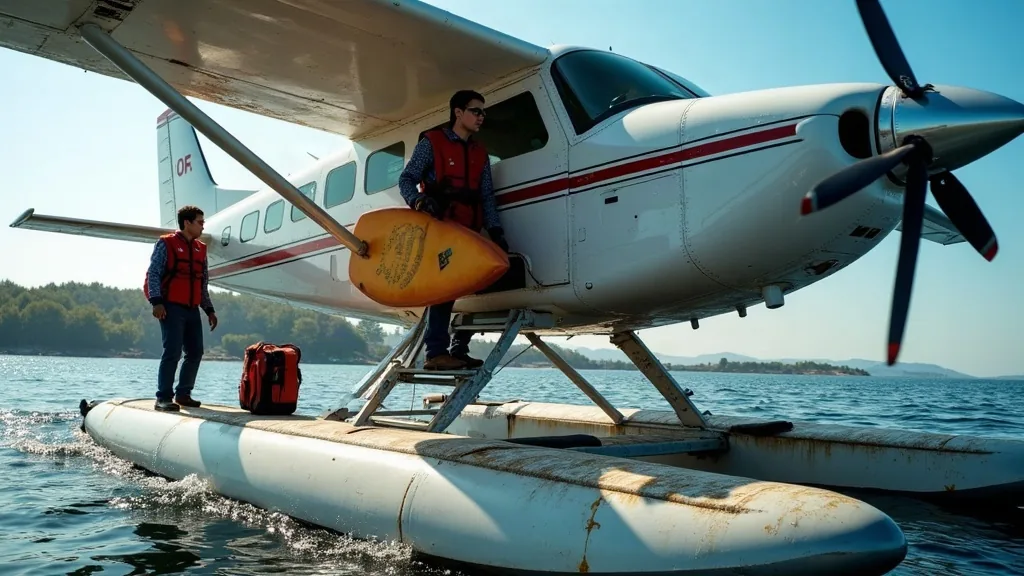
Booking a seaplane with more than a soft bag means declaring your luggage before you fly, not at the dock. List every hard case, dive set, surfboard or camera rig by piece count, weight and dimensions in your flight request, because Indonesian seaplane operators price and load charters around exact payload — not a printed baggage allowance like a scheduled airline uses.
Why Doesn’t a Seaplane Use a Standard Baggage Allowance?
A seaplane charter is not a scheduled flight with a fixed hold. Under Permenhub PM 33 Tahun 2022 — the rule the Directorate General of Civil Aviation (DGCA), under the Ministry of Transportation in Jakarta, uses to define charter operations — a non-scheduled flight is capped at 30 seats or a set maximum takeoff weight (MTOW), whichever the aircraft’s certification hits first. Passengers and luggage share that MTOW ceiling, so an operator weighs the whole flight as one number, not a separate baggage allowance.
A Cessna Caravan amphibian carrying eight guests has far less spare payload than a wide-body jet, so a few extra kilograms of dive gear matter more here than on a domestic jet flight. For contrast only, Garuda Indonesia’s standard domestic economy fare allows one 23 kg checked piece — an airline benchmark, not a seaplane rule. No Indonesian seaplane operator publishes a fixed per-passenger kilogram limit as of 17 September 2026; each sets its own figure per aircraft and route, confirmed once your booking desk sends your details.
What Should You Declare Before You Book?
Send a luggage brief alongside your route and passenger count, not after your quote arrives. This is what a booking desk needs to relay to the operator for an accurate payload check.
| Item to Declare | What to Specify | Why It Matters |
|---|---|---|
| Piece count | Bags per passenger | Payload is calculated per flight, not per person |
| Weight per piece | Kilograms, each bag separately | One heavy case can force a re-weigh of the manifest |
| Dimensions | Length x width x height (cm) | Amphibian cabins and holds have fixed openings |
| Case type | Hard-shell vs soft duffel | Rigid cases take fixed volume; soft bags flex around gaps |
| Camera and drone rigs | Case size, battery count, tripod length | Long lenses and tripods can exceed hold dimensions |
| Dive gear | BCD, regulator, tanks (full or empty), weights | Steel tanks and lead weights are dense for their size |
| Surfboards and paddleboards | Length, quantity, bagged or not | Long boards may not clear the cabin door at any weight |
| Lithium batteries / dangerous goods | Watt-hour rating, spare vs installed, quantity | Governed by IATA dangerous-goods rules the operator must follow |
What Happens When Your Bags Exceed the Aircraft’s Payload?
Every operator handles an overweight manifest differently, and the options below are typical charter responses under MTOW limits — not a fixed policy any single carrier has published. Confirm the actual approach once your brief is reviewed.
| If Payload Is Exceeded | What Usually Happens | Operator-Dependent Factor |
|---|---|---|
| Slightly over MTOW | Passengers and bags re-balanced across seats and holds | Aircraft type, fuel load, weather margin that day |
| Bags too bulky for the cabin | Oversized items sent on a second rotation | Whether the operator has a spare slot |
| Cargo needs its own manifest | Gear shipped separately, arriving before or after guests | Route distance, availability of a freight partner |
| Consistently heavy group | Extra fee per excess kilogram or per rotation | Set by the operator per aircraft, not industry-wide |
| Dangerous goods flagged | Item refused, repacked, or shipped by another carrier | IATA rules plus the specific AOC holder’s own policy |
How Does Booking With a Luggage Brief Work?
- Send your route and dates. Tell the desk where you fly from and to, and how many passengers.
- Attach your luggage brief. List every non-standard item using the table above.
- Receive a payload-checked quote. The desk relays your brief to the relevant licensed operator, who confirms whether everything travels on one flight or needs adjusting.
- Confirm re-balancing or a second rotation if needed — before payment, not at the pier.
- Pay the deposit to hold the slot. Charter deposits commonly run 30-50 percent of the fare, balance due 7-14 days before departure — typical charter practice, not a rule every operator publishes.
- Reconfirm 24-48 hours out, when weather, tide and any late luggage changes are checked again.
What Should Go Into Your Luggage Brief?
Keep it short but specific: passenger names, total bag count, a weight for every piece over 10 kg, dimensions for anything longer than a carry-on, and a flag for lithium batteries or dive tanks. A photo of an oversized item helps the desk relay an accurate picture on the first pass, rather than after a quote comes back wrong.
Reference Flight Example (Illustrative Only)
This is one operator’s published scenic product, shown only to illustrate how seaplane pricing is structured by guest count and duration — not a luggage-specific rate. Ask your desk for a payload-checked quote once your bags are declared.
| Product (as of 2026) | Duration | Capacity | Indicative Starting Price |
|---|---|---|---|
| Scenic flight, Ngurah Rai departure | 40 minutes | Up to 8 guests | Quoted per flight (full aircraft), plus separate airport fee and tax |
| Route charter, island-to-island | Varies by distance | Per-guest or full-charter | Quoted per route; luggage load affects the final figure |
| Luggage-heavy multi-destination request | Varies | Confirmed after brief review | Quoted individually once payload is checked |
Prices and products change; treat the scenic-flight pricing as one operator’s reference as of 2026, subject to change, and request a current quote for your dates.
Ready to Send Your Luggage Brief?
Juara Holding Group is an independent booking and coordination desk, established 2015 — not a seaplane operator, not affiliated with any operator named on this page. We relay your route, passenger count and luggage brief to the relevant licensed operator and bring back a payload-checked quote. Send your bag list — piece count, weight, dimensions, plus any dive gear, boards or batteries — to WhatsApp 6281139414563 or bd@juaraholding.com, and we confirm what fits on one flight and what needs a second rotation before you pay a deposit.
Frequently Asked Questions
Can I bring a surfboard on a seaplane charter?
Often yes, but length matters more than weight — a board over roughly 7 feet may not clear a Caravan amphibian’s cabin door regardless of how light it is. Declare the exact length and whether it is bagged in your luggage brief, so the desk can confirm with the operator before you book, rather than at the dock.
How many kilograms of luggage can I bring on a seaplane in Indonesia?
No Indonesian seaplane operator publishes a fixed per-passenger kilogram limit as of 2026; each sets its own figure per aircraft, route and fuel load under MTOW rules. Send your exact piece count, weight and dimensions with your booking request, and the desk relays them to the operator for a payload-checked answer specific to your flight.
Do lithium batteries and dive gear need approval before a seaplane flight?
Yes. Lithium batteries fall under IATA dangerous-goods rules, so spare batteries, watt-hour ratings and quantities must be declared in advance. Dive gear itself is not restricted the same way, but full steel tanks are dense and heavy, so weigh and declare them separately to avoid a payload surprise at check-in.
What happens if my luggage does not fit on the aircraft?
The operator typically re-balances the load across seats and holds first; if bags are still too bulky or heavy, oversized items may travel on a second rotation or ship separately as freight. Which option applies depends on the specific operator and aircraft that day, which is why declaring gear early gives the desk time to arrange it.
Should I send my luggage list before or after I get a quote?
Before. A quote built without your luggage brief may need revising once the operator sees your actual bag count and weight, which can delay confirmation. Sending piece count, weight and dimensions alongside your route request the first time gets you a payload-checked figure in one pass instead of two.