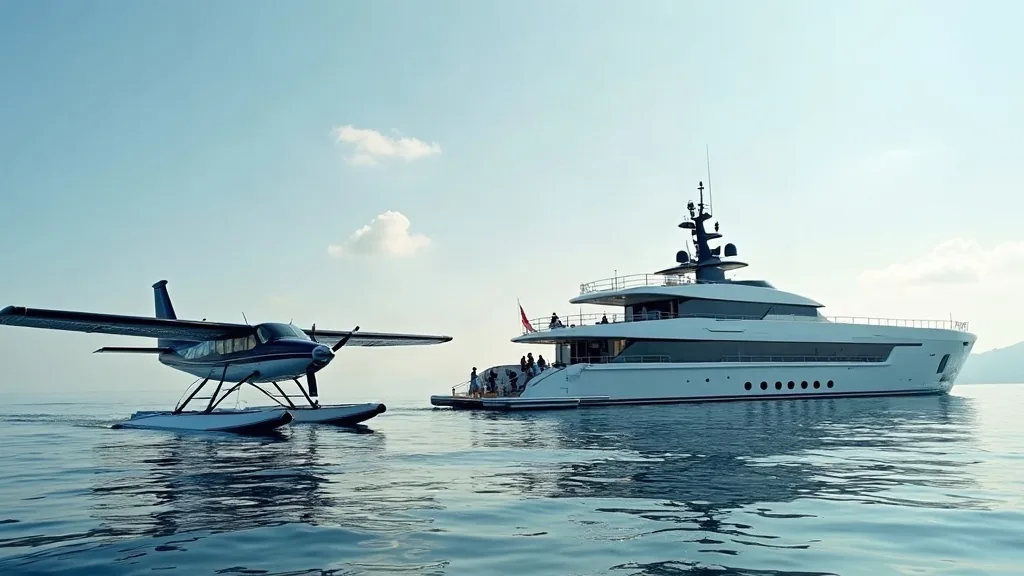
Seaplane Transfer to Yacht
A seaplane transfer to a yacht in Indonesia is booked as a private charter that lands at an operator-approved water site near the vessel’s anchorage, marina berth, or a designated tender point, coordinated ahead of time between the captain, a local port agent, and a DGCA-licensed operator. Juara Holding Group’s concierge desk takes the brief and routes it to a vetted charter partner — it does not operate the aircraft itself.
Owners, captains, and charter brokers use this route when a guest needs to join or leave a yacht without burning a day on road-and-tender transfers, or when an itinerary spans islands a road transfer cannot reach at all. The desk exists to remove the coordination friction between two moving parties — an aircraft and a vessel — not to sell seats on a fixed schedule.
How Does a Seaplane-to-Yacht Rendezvous Actually Work?
A yacht rendezvous is not a scheduled-route booking. It is closer to arranging two charters that meet at one point in time: the aircraft’s flight plan and the yacht’s position both have to be fixed and confirmed before departure.
In practice, three things happen before wheels-up:
- The rendezvous point is agreed — marina berth, open anchorage, or a tender standing by at a pre-set coordinate.
- The operator checks that the site is one it is cleared to use for a water landing.
- A local agent or the captain confirms sea state and traffic in the area on the morning of the flight.
Indonesia’s charter framework requires this level of planning anyway. Under Law No. 1 of 2009 on Aviation, Article 63(1) restricts operations inside Indonesian territory to Indonesian-registered aircraft, and Permenhub PM 33 Tahun 2022 defines a charter operation as non-scheduled commercial transport, typically capped at 30 seats. A foreign non-scheduled aircraft needs Directorate General of Civil Aviation (DGCA) and defence clearance at least 14 working days ahead, with the actual flight plan lodged 24 hours before departure — so a same-day yacht rendezvous is not something any operator can improvise (Ministry of Transportation / DGCA framework, as of 2026-09-17, subject to change).
What Does the Captain Need to Prepare Before the Flight?
The single biggest cause of a delayed or aborted rendezvous is missing vessel information. The desk asks for the following before it sends a request to an operator:
| Item | Why the operator needs it |
|---|---|
| Yacht name and flag | Identification for port and DGCA paperwork |
| AIS / MMSI number | Lets the operator or agent track the vessel’s live position |
| Rendezvous coordinates | Anchorage, marina slip, or open-water tender point |
| Tender availability | Confirms guests can be moved the last few metres from aircraft to yacht |
| Backup landing point | A second site if the primary spot is unworkable on the day |
| Bad-weather plan | What happens if sea state or wind rules out a water landing |
| Local agent contact | Handles port clearance and on-water coordination at the destination |
A captain who sends this table filled in when the enquiry goes out usually gets a firmer quote and a firmer time slot back, since the operator is not left guessing at conditions.
How Much Time Should You Buffer Around the Rendezvous?
Operators do not publish a single fixed buffer, because it depends on the aircraft, the route, and the day’s sea state — this is operator-dependent, not a fixed industry rule.
| Planning factor | General guidance |
|---|---|
| Buffer around the rendezvous window | Allow roughly 1-2 hours either side for a private charter, longer for multi-leg itineraries |
| Time of day | Morning slots are generally more reliable — sea breezes and swell tend to build through the afternoon |
| Sea-state limits | Set by the operator on the day, not by the booking desk; a marginal call can shift the site or the time |
| Multi-destination legs | Each additional stop (resort, second yacht, airport) adds its own buffer, not a simple multiple |
Building in slack matters more for a yacht rendezvous than for an airport transfer, because the “runway” is a patch of open water that can change character within the same morning.
Why Can’t a Seaplane Just Land Anywhere Near the Yacht?
Water landings near a yacht are not open-ended. The operator has to confirm the specific site is one it is approved to use, and in many cases a local agent handles port clearance with the harbour master or park authority before the aircraft is cleared in.
A few reference points on how this plays out around Indonesia, as of 2026-09-17:
- Menjangan, on Bali’s northwest tip, holds approved water-landing permits and has been cited by operators planning North Bali routes.
- Santai Seaplane, a subsidiary of Hong Kong-based Seaplane Asia Group, has announced amphibious service from Bali and Banyuwangi with a hub at Banyuwangi Airport (BWX), which has an approved water aerodrome; its Scenic Bali product uses a Cessna Caravan 208 EX Amphibian carrying up to 8 guests.
- Sama Sama Seaplanes states it can arrange charters across Indonesia, describing itself as the country’s first sustainable seaplane operator (site updated 2026-07-03).
- Komodo National Park entry carries a fee per foreign visitor per visit, plus ranger, conservation, and dock fees — relevant if the rendezvous sits inside park waters.
- Raja Ampat liveaboard routes run mainly October to April, and Komodo sailing concentrates in the dry season, which is why yacht positions — and rendezvous planning — shift with the calendar.
None of this is guaranteed availability for a given date. It is context for why the desk asks for a backup landing point and a named local agent before it sends the request out.
What Does a Seaplane-to-Yacht Transfer Cost, and How Long Does It Take?
No Indonesian seaplane operator publishes a fixed price list for yacht rendezvous transfers — pricing is quote-based, built around aircraft type, distance, number of guests, and the complexity of the water-landing clearance.
| Transfer type | Typical duration | How pricing works |
|---|---|---|
| Single-leg marina-to-yacht hop | 20-45 minutes flight time | Quoted per charter, driven by aircraft type and distance |
| Airport-to-yacht handover | 30-60 minutes flight time | Quoted per charter; airport fees and taxes are usually itemised separately |
| Multi-destination (yacht + resort or second yacht) | Half-day to full-day charter | Priced as a full-charter itinerary, not per leg |
| Reference point only | — | Santai Seaplane’s Scenic Bali product is priced as a full-aircraft charter, as the operator does not sell individual seats; indicative per-guest figures for other routes can be found per the operator’s published figures from Ngurah Rai, with airport fees and tax shown separately — cited here only as a public example of cost scale, not a yacht-transfer rate |
Deposit and cancellation terms follow general charter practice — commonly 30-50% deposit with the balance due 7-14 days before the flight — but this is a typical pattern, not a published rule, and it varies by operator.
How Do You Book a Seaplane Transfer to Your Yacht?
- Send the brief. Yacht name, AIS/MMSI, rendezvous coordinates, guest count, and preferred date range.
- Desk checks feasibility. The request goes to a licensed operator with amphibious aircraft serving the relevant region.
- Operator confirms the site. Primary and backup landing points are checked against approved water-landing locations.
- Quote comes back. Aircraft type, timing window, and price are itemised; deposit terms are stated by the operator.
- Local agent locks logistics. Port clearance, tender timing, and the bad-weather contingency are confirmed close to the date.
- Flight plan is lodged. For foreign-registered charter aircraft, this follows the DGCA timeline — clearance requested at least 14 working days out, flight plan filed 24 hours before departure.
Can This Connect to the Wider JHG Yacht Network?
Where useful, the desk cross-sells into Juara Holding Group’s broader yacht-charter coordination — matching a seaplane rendezvous to a charter itinerary already being arranged, rather than treating the flight as a standalone booking. This covers transfer and coordination requests only. Yacht purchase, build, and refit enquiries are handled on a separate route and are not part of this booking desk.
Book the Transfer
Juara Holding Group is an independent booking and coordination desk, established 2015 — not an aircraft operator, and not affiliated with any named operator on this page. Every request is matched to a licensed Indonesian charter partner and priced by that operator, subject to DGCA clearance and water-landing approval. Send the yacht name, AIS/MMSI, rendezvous coordinates, and preferred dates to the desk on WhatsApp 6281139414563 or bd@juaraholding.com, and the team will come back with operator options and a firm timing window.
Frequently Asked Questions
How far in advance do I need to book a seaplane transfer to my yacht?
Start at least three to four weeks out. Foreign-registered charter aircraft need DGCA and defence clearance at least 14 working days ahead, and the operator still has to confirm the water-landing site, aircraft availability, and a local agent — so late requests limit which dates and aircraft are realistically available.
Can a seaplane land right next to my yacht at anchor?
Only at a site the operator is cleared to use for water landings — not at any anchorage by default. The desk asks for a primary rendezvous point and a backup, and the operator or local agent confirms clearance before the flight is booked.
What information does the operator need about my yacht before quoting?
Yacht name, AIS/MMSI number, rendezvous coordinates, tender availability, a backup landing point, a bad-weather plan, and a local agent contact. Sending this filled in with the initial enquiry, rather than after, typically shortens the time it takes to get a firm quote back.
What happens if sea conditions are too rough for a water landing near the yacht?
The operator decides on the day, using its own sea-state limits — this is not set by the booking desk. That is why a backup landing point and bad-weather plan are asked for upfront; without them, a marginal call can mean rescheduling rather than diverting to an alternative site.
Can the seaplane transfer connect with a liveaboard or resort itinerary as well as a private yacht?
Yes — the same rendezvous process applies whether the vessel is a private yacht, a liveaboard, or a resort transfer point, and multi-destination legs can be quoted as one itinerary. Raja Ampat liveaboard routes run mainly October-April, and Komodo sailing concentrates in the dry season, which affects vessel positioning and available dates.